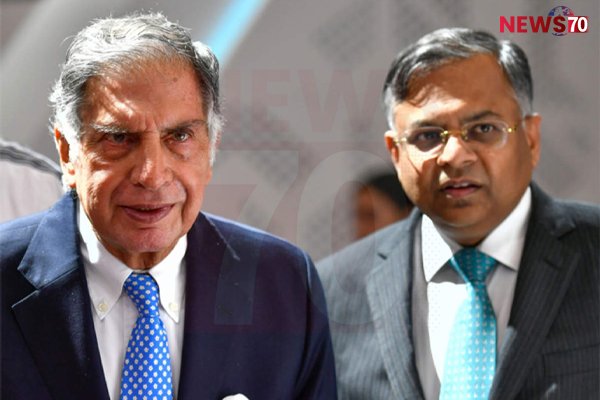
A year after Ratan Tata’s death, the Tata Group faces renewed internal turmoil as trustees clash over control, governance, and a possible public listing of Tata Sons. The rift, involving figures close to the late chairman, has forced government attention amid wider business challenges — from Air India’s revival to TCS’s struggles. Experts say the conflict exposes deeper structural issues within the Trust-controlled conglomerate, threatening its stability and global reputation.
Tata Group: A Divided Empire Faces Renewed Boardroom Turmoil
A year after the death of Ratan Tata, the Tata Group — India’s vast salt-to-steel conglomerate that he transformed into a global, technologically driven powerhouse — is once again grappling with internal turmoil and a series of crises.
The business empire, which owns iconic British brands such as Jaguar Land Rover (JLR) and Tetley Tea, and manufactures Apple’s iPhone in India, finds itself deeply divided.
For months, a power struggle within the boardroom has exposed rifts among trustees, prompting government intervention to avert a repeat of the public legal feud that shook the group in 2016, when then-chairman Cyrus Mistry was abruptly ousted.
Although officials in Delhi appeared to have brokered an uneasy truce weeks ago, new reports suggest that Mehli Mistry — a close confidant of Ratan Tata and a trustee on the Tata Trusts board — has been removed from his position. The BBC has not independently verified this claim.
According to Prof. Mircea Raianu of the University of Maryland, author of a definitive history of the corporation, the latest confrontation reflects the “resurfacing of unresolved business” — specifically, the enduring question of who truly controls the Tata empire and how much authority majority shareholders, the Tata Trusts (which own 66% of Tata Sons), should have over business decisions.
The Tata Group’s structure is unique: the controlling stake in Tata Sons, its unlisted holding company, lies with Tata Trusts, a philanthropic body. While this arrangement provides regulatory and tax benefits and enables large-scale charitable initiatives, analysts note that it also creates governance challenges, given the conflicting aims of nonprofit stewardship and commercial ambition.
The current tensions come as the group navigates significant business challenges — from pushing into new growth areas such as semiconductors and electric vehicles to reviving Air India, the debt-laden airline it reacquired from the government in 2021, which was hit by a fatal crash earlier this year.
What Went Wrong
Though Tata has not publicly commented on the internal discord, reports indicate that the dispute stems from disagreements among trustees over board nominations, funding approvals, and the potential public listing of Tata Sons — the parent company of 26 listed Tata firms with a combined market capitalization of roughly $328 billion.
A source close to the group told the BBC, on condition of anonymity, that some trustees want greater influence over strategic decision-making at Tata Sons, including who sits on its board. The Tata Trusts currently hold three board seats.
“The Tata Trusts nominees have veto power in major company matters, but traditionally their role has been supervisory, not assertive,” the source said. “Now, however, some trustees are seeking more authority to drive commercial decisions.”
Another major flashpoint is the SP Group’s push to take Tata Sons public. Holding an 18% stake, the SP Group is the company’s largest minority shareholder. While it argues that a listing would improve transparency and unlock shareholder value, most Tata trustees remain opposed.
“There’s concern that going public would weaken the Trusts’ long-term influence, expose the group to quarterly market pressures, and complicate decision-making — especially with so many emerging ventures still in their early stages,” the source explained.
Nevertheless, the SP Group insists that listing the company is a “moral and social imperative” to enhance accountability and governance.
Neither Tata Sons nor Tata Trusts responded to the BBC’s detailed inquiries. However, Prof. Raianu notes that the situation exposes a deep dilemma for the conglomerate.
According to him, taking the company public would run contrary to the trend seen among large Western corporations, many of which are shifting to foundation ownership models — ironically inspired by the Tata example — to strengthen long-term stability and sustainability.
“But,” he cautioned, “private or closely held firms also face less external scrutiny, which can foster internal conflict and harm reputation.”
Brand and Governance Under Strain
Publicist Dilip Cherian, who once worked closely with former chairman Cyrus Mistry, says the ongoing dispute risks tarnishing one of India’s most respected business legacies.
“This only adds to the series of blows the Tata image has suffered recently,” Cherian told the BBC, citing the tragic Air India crash and a cyberattack on JLR that crippled UK car production, plunging it to a 70-year low in September.
Meanwhile, Tata Consultancy Services (TCS) — the group’s flagship IT arm that contributes nearly half of its total revenue — faces its own set of troubles, including mass layoffs and the abrupt termination of a $1 billion contract with retailer Marks & Spencer.
“These boardroom battles create more confusion,” Cherian warned. “Beyond share price anxiety, investors are now questioning who exactly is in charge at Tata.”
Amid the ongoing upheaval, reports suggest that Tata Sons Chairman N. Chandrasekaran’s tenure has been extended.
According to a source close to Tata Sons, “The chairman can continue with his duties, as the conflict lies between the trustees, not the board itself. However, it remains an unwelcome distraction.”
The Tata Group, however, is no stranger to internal strife. In the 1990s, Ratan Tata faced intense resistance while modernising the group’s structure, and the bitter feud that followed Cyrus Mistry’s ouster still lingers in public memory.
This time, though, there’s a key difference, notes Professor Mircea Raianu.
“Earlier, struggling Tata companies were supported by TCS, ensuring stability. Before that, Tata Steel played this crucial role,” he explains.
Currently, with TCS’s business model in transition and its share of the group’s overall revenue under strain, no similar “anchor” has yet emerged — leaving the conglomerate more vulnerable to internal fractures.
“It’s destabilising and could be damaging in the short term,” Prof. Raianu adds, “but this turbulence may eventually pave the way for a more transparent and accountable structure once the dust settles.”