
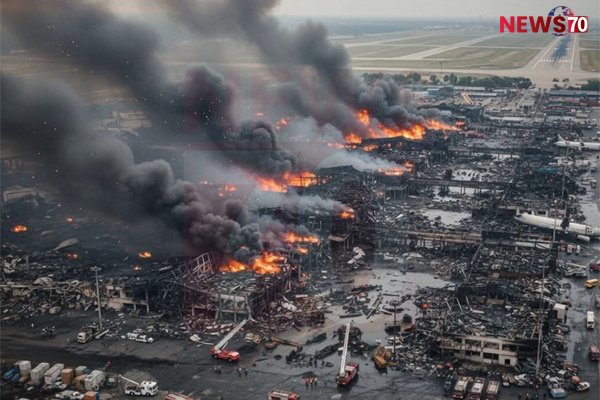
A devastating fire at Dhaka’s Hazrat Shahjalal International Airport cargo complex has sparked fears of over $1 billion in trade losses. Exporters say the blaze could severely disrupt Bangladesh’s import and export chains, particularly in the garment, textile, and pharmaceutical sectors. Industry leaders from BKMEA and BGMEA report that hundreds of consignments, including crucial accessories and raw materials, may have been destroyed, threatening production schedules and small business survival.
Dhaka Airport Fire May Cause Over $1B Trade Impact, Say Exporters
Though the full extent of direct damage from the fire at Hazrat Shahjalal International Airport’s air cargo complex in Dhaka is yet to be assessed, traders fear the incident could deal a blow of more than $1 billion to Bangladesh’s import and export activities.
Kabir Ahmed Khan, president of the International Air Express Association of Bangladesh, told The Business Standard, “It’s too early to estimate the direct losses. But the overall impact—both direct and indirect—on imports and exports could exceed $1 billion.”
Fazlee Shamim Ehsan, executive president of the Bangladesh Knitwear Manufacturers and Exporters Association (BKMEA) and a ready-made garment exporter, voiced similar concerns.
Apart from garments, the cargo village warehouses also store raw materials for pharmaceuticals, agriculture, and other commercial imports. Ehsan, who had accessories stored in the affected area, said more than 500 garment exporters had small consignments there. “The value of individual items may be low, but collectively they represent exports worth millions of dollars,” he said.
“For instance, I may have lost accessories worth only $2,000, but that could delay exports worth around $200,000,” he added. “These items are imported by air because they’re urgently needed. If they’re destroyed, re-importing will take time—and I may have to ship by air again, which costs nearly half the product’s value. Otherwise, the buyer might demand a 50% discount. Small businesses can’t recover from such losses.”
Md Shehab Udduza Chowdhury, vice-president of the Bangladesh Garment Manufacturers and Exporters Association (BGMEA), expressed similar fears.
Officials from the International Air Express Association of Bangladesh said roughly one-third of all import and export goods handled via air cargo belong to the apparel and textile sector. Over 60 international air courier services currently operate in Bangladesh.
The BGMEA said garment manufacturers are now assessing how many consignments and what values have been affected. BGMEA President Mahmud Hasan Khan Babu told TBS, “On Saturday, we emailed all our members, asking them to report what goods they had stored in air cargo.”
He noted it was still too early to quantify losses. He himself had imported accessories and machinery in the cargo area, but as of Saturday evening, he didn’t know whether his consignments were safe or burned. “If those shipments don’t arrive on time, I could face heavy export losses,” he said.
Emran Ahmed, managing director of Zemtex Linkage Industries Ltd, an export-oriented garment manufacturer, told TBS, “I had about 40 kg of lace accessories imported from India stored in the cargo village. My C&F agent said there’s a 98% chance they were burned. The fire started in the courier section, where my goods were.”
“I imported those accessories by air for an urgent shipment worth $162,000 in exports. That shipment will likely be cancelled, as I’ve already missed the October 30 deadline,” he said.
Last year, Bangladesh’s garment exports totaled nearly $40 billion.
The cargo village is mainly used for importing lightweight machinery and electronics, as well as handling small quantities of garments, samples, accessories, documents, and parcels for import and export.
According to media reports, a representative of a pharmaceutical company said chemical ingredients worth $75,000 had been destroyed. “I tried to clear the goods on Thursday but couldn’t. They were scheduled for release on Sunday—but everything’s gone now,” he said.