
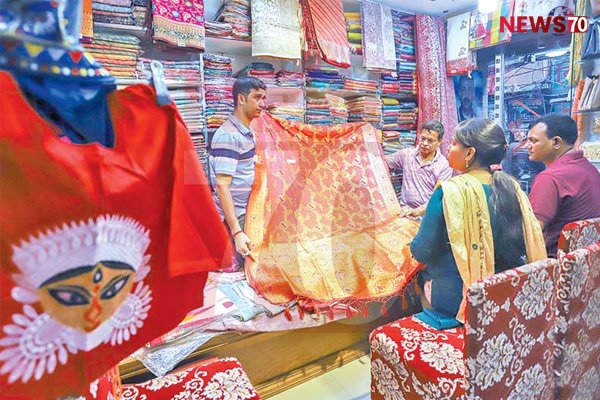
Despite initial concerns over inflation, weak purchasing power, and economic uncertainty, Durga Puja sales in Bangladesh exceeded expectations this year. Retailers like Rang Bangladesh, Kay Kraft, Anjan’s, Le Reve, and Lanthon reported strong demand, particularly for saris, panjabis, and festive accessories. Red and white remained the most popular colours, while younger buyers experimented with new styles. The festival drew enthusiastic shoppers, including families buying gifts, highlighting that local brands can thrive even when cross-border shopping is limited.
Festival seasons are generally a boon for retailers, but this year many approached the Durga Puja season cautiously. Rising inflation, weak consumer purchasing power, and overall economic uncertainty had raised concerns that spending might fall short.
Contrary to those worries, sales picked up during the ten-day festival and, in many cases, exceeded expectations. For Bangladesh’s over 13 million Hindus, Durga Puja remains the largest and most eagerly awaited festival of the year.
Soumik Das, manager of Rang Bangladesh, a popular fashion house with 19 outlets nationwide, reported a 10 percent year-on-year increase this Puja season. He attributed the growth to several factors, including India’s recent visa restrictions. “Many people usually travel to India to shop during this season. But with the ban, those customers turned to the local market,” he said.
Kay Kraft, a major fashion and lifestyle retailer with 14 outlets, also noted strong demand, particularly in Sylhet and large shopping malls like Jamuna Future Park and Bashundhara City. Khalid Mahmood Khan, co-founder and CEO, said, “There were initial concerns about sales, but the overall response has been positive. Some locations performed better than others, but overall it was encouraging.”
A Colourful Festival for Retailers
Industry insiders estimate that Bangladesh’s two Eids account for roughly 70 percent of annual festival sales, with Durga Puja and Pahela Baishakh making up the remainder. Despite this, the Puja season remains crucial for fashion retailers, as shoppers prepare weeks in advance, prioritising saris, panjabis, and festive accessories.
Red and white attire continues to dominate consumer preference, though younger buyers are exploring new colours and prints. Discounts, bundle offers, and limited festive collections were widely used to attract shoppers.
Several major brands reported strong sales this season. Anjan’s, with 22 stores across major cities, saw high demand for saris, panjabis, salwar kameez, shirts, and fatuas. “Red and white remain the most popular colours for Puja, and this year sales have been very encouraging,” said Shaheen Ahmed, CEO of Anjan’s. “Every festival has its own pattern, and for Puja, these colours are always in high demand.”
Le Reve, another leading ethnic and casual fashion brand with 26 showrooms nationwide, also reported brisk business. CEO Monnujan Nargis said, “Customers eagerly wait for new colours and trends each season.”
Boutique retailer Lanthon, located at Aziz Super Market in Dhaka, experienced similarly positive sales. Founder Ujjal Akash noted that brightly coloured panjabis and saris were the most popular items. “It is a colourful time,” he said, adding that a price range of Tk 1,000 to 1,500 attracted a wide spectrum of buyers.
For individual shoppers, the festival is an occasion to spend. Priyanka Chakraborty, a 30-year-old professional, shared, “I’ve been saving for months for this festival. We exchange gifts among family members. I bought a couple of kurtis for myself, one for my sister, and a sari and panjabi for my parents. I also picked out outfits for my niece and nephews.”
Other shoppers echoed similar sentiments. Subrata Chanda bought a pair of shoes, pants, and shirts, while businessman Shaikat K Das Ricky from Mirpur spent Tk 6,000 on a sari and panjabi for his parents, also receiving a gift shirt and panjabi for himself.
Although Durga Puja is primarily a Hindu festival, it has grown into a broader cultural celebration in Bangladesh. For retailers, this year’s festival was not just another seasonal boost but a clear indication that local brands can capture strong consumer demand when cross-border shopping is limited.