
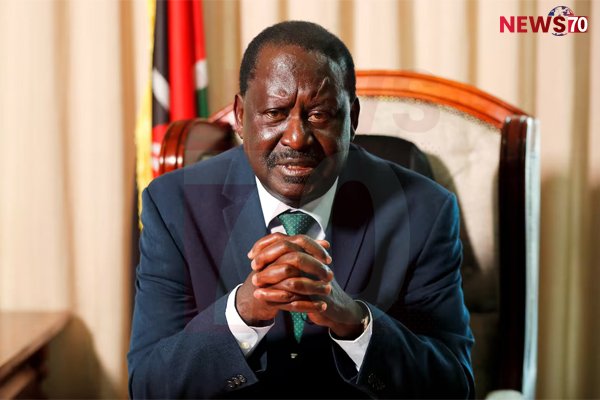
Former Kenyan Prime Minister Raila Odinga has died at age 80 while receiving treatment in India after suffering a cardiac arrest. Kenyan President William Ruto hailed him as the “father of democracy” and declared seven days of national mourning. Global leaders, including India’s Narendra Modi and South Africa’s Cyril Ramaphosa, paid tribute to Odinga’s legacy as a towering statesman and pro-democracy icon. Odinga, a five-time presidential candidate, was a pivotal figure in Kenya’s political history and the country’s longest-serving political prisoner. His death marks the end of an era in Kenyan politics.
Former Kenyan Prime Minister Raila Odinga has died at the age of 80, family sources confirmed to the BBC.
Odinga passed away on Wednesday while undergoing medical treatment in India. He reportedly collapsed during a morning walk and was taken to Devamatha Hospital, where doctors said he suffered a cardiac arrest. Despite resuscitation efforts, he was pronounced dead at 09:52 local time (04:22 GMT).
Speculation about Odinga’s health had circulated in recent weeks, though his family and close allies had denied claims that he was critically ill.
President William Ruto paid tribute to Odinga, calling him a “beacon of courage” and the “father of our democracy.”
In a national address, Ruto described him as “a once-in-a-generation leader whose ideals transcended politics and whose legacy will guide Kenya for generations.” He also declared seven days of national mourning and announced that Odinga would receive a state funeral with full honours.
World leaders have joined in paying tribute. Indian Prime Minister Narendra Modi hailed Odinga as a “towering statesman and a cherished friend of India.” South African President Cyril Ramaphosa called him “a leader who put his country and continent first,” while Zambia’s Hakainde Hichilema remembered him as “a tireless advocate for democracy.”
Earlier, President Ruto visited Odinga’s Nairobi home to offer condolences to his widow, Ida Odinga, and family members. A delegation led by Foreign Minister Musalia Mudavadi and Ida Odinga is set to travel to India to oversee the repatriation of his body.
Mourners have flooded the streets in Odinga’s strongholds across western Kenya and parts of Nairobi.
A central figure in Kenyan politics, Odinga was known for his unmatched political influence and mass appeal. He contested the presidency five times without success, rejecting the outcome each time, often alleging electoral fraud.
His persistence was validated in 2017 when Kenya’s Supreme Court annulled President Uhuru Kenyatta’s victory and ordered a rerun, which Odinga later boycotted, demanding electoral reforms.
In a surprise reconciliation, Odinga and Kenyatta shook hands in 2018, ending months of political tension.
Odinga’s disputed 2007 election against Mwai Kibaki triggered Kenya’s worst political crisis, leading to over 1,200 deaths and displacing around 600,000 people. The conflict ended after former UN Secretary-General Kofi Annan brokered a power-sharing deal that made Odinga prime minister.
Throughout his career, Odinga often reconciled with sitting presidents after contentious elections. Following his 2022 defeat, he joined President Ruto in a broad-based government, saying the move promoted national unity after mass protests that led to deadly clashes with security forces.
The Ruto government supported Odinga’s bid for African Union Commission chair earlier this year, though he lost to Djibouti’s Mahmoud Ali Youssouf.
Odinga inspired a loyal following, especially in western Kenya, where he was born. Supporters affectionately called him “Baba” (Father), “Agwambo” (Act of God), and “Tinga” (Tractor) — the symbol of his 1997 campaign.
He was renowned as a master strategist, charismatic orator, and tireless campaigner who connected deeply with ordinary Kenyans.
A lifelong champion of democracy and human rights, Odinga spent years in detention during Daniel arap Moi’s regime, becoming Kenya’s longest-serving political prisoner. He was imprisoned twice — from 1982 to 1988 and again from 1989 to 1991 — after being accused of involvement in a failed coup attempt in 1982, an event that launched his political career.
For decades, Raila Odinga stood as a symbol of resistance and reform in Kenyan politics. His death leaves a major void in the nation’s leadership and raises questions about who will continue his legacy.
He was the son of Jaramogi Oginga Odinga, Kenya’s first vice-president, who resigned after clashing with founding leader Jomo Kenyatta, father of former president Uhuru Kenyatta.