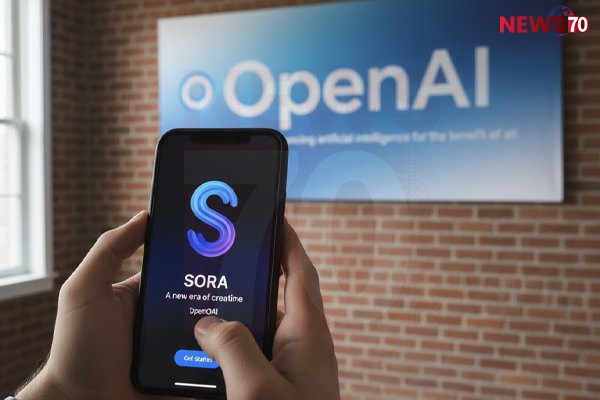
OpenAI’s text-to-video AI app, Sora, reached 1M downloads in under five days, surpassing ChatGPT’s launch speed. The app generates short realistic videos from text prompts and is popular on social media. However, it faces criticism for copyright issues and depictions of deceased public figures. OpenAI plans to give rights holders more control and explore revenue-sharing, while legal challenges around AI-generated content continue.
OpenAI reports that its latest text-to-video AI tool, Sora, has been downloaded over one million times in under five days—reaching the milestone faster than ChatGPT at its launch.
The app, which has topped the Apple App Store charts in the US, allows users to generate ten-second, realistic-looking videos from simple text prompts.
Sora’s rapid growth was highlighted in an X post by Sora CEO Bill Peebles, who noted that this surge occurred even though the app was initially available only to invited users in North America.
However, the app has faced significant criticism online for its handling of copyrighted material and for generating images of deceased public figures.
Sora makes it easy for users to share AI-generated videos on social media, leading to a flood of content. Some of these videos have depicted deceased celebrities such as musicians Michael Jackson and Tupac Shakur.
Recently, Zelda Williams, daughter of the late actor Robin Williams, urged people to stop creating and sending AI videos of her father, linking the appeal to Sora’s growing popularity.
BBC Bitesize has explored the rising trend of AI-generated videos of deceased celebrities.
An OpenAI spokesperson told Axios that there are "strong free speech interests" in allowing depictions of historical figures. However, for public figures who have “recently” passed away, authorized individuals can request that their likeness not be used, though the company did not define what counts as “recent.”
Copyright Concerns
Sora videos often feature characters from movies, TV shows, and games. In one viral deepfake, OpenAI CEO Sam Altman appears alongside several Pokémon characters, joking, “I hope Nintendo doesn't sue us,” while in another, he grills and eats Pikachu.
Although Nintendo has not announced any legal action, OpenAI and other generative AI companies are already involved in legal disputes with creators and rights holders over the use of copyrighted works. These lawsuits can be costly; for example, AI company Anthropic agreed to a $1.5 billion (£1.11bn) settlement in a class-action case brought by authors whose works were allegedly used to train AI models.
OpenAI says it is adjusting its approach in response to these challenges. On October 4, Sam Altman blogged that the company is “learning quickly from how people are using Sora” and is taking feedback from users, rights holders, and other stakeholders.
Altman also noted plans to give rights holders more detailed control over character generation and hinted at future revenue-sharing opportunities.
It remains unclear whether rights holders will accept Sora videos as a form of “interactive fan fiction,” as Altman suggested, or if the company will face legal scrutiny in civil courts.