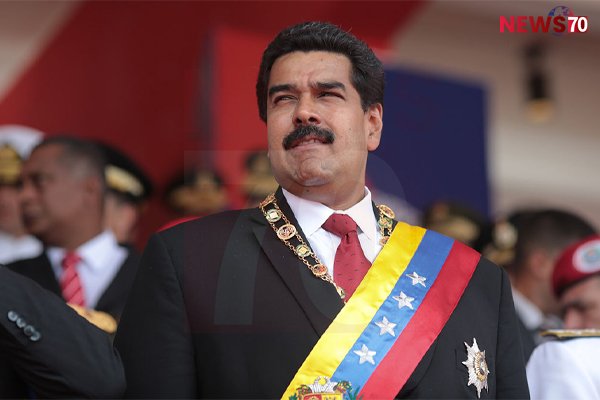
US President Donald Trump confirmed he authorized CIA covert operations in Venezuela, sparking outrage from Caracas. Trump cited drug trafficking and prisoner releases as reasons, while Venezuelan President Nicolás Maduro condemned the move, warning against regime change and US aggression. The US has stepped up military activity in the Caribbean, including recent deadly strikes on suspected drug boats. Venezuela has mobilized its forces, accusing Washington of warmongering, as tensions escalate between the two nations.
Trump Confirms CIA Authorization in Venezuela as Maduro Rejects Regime Change
US President Donald Trump has confirmed reports that he authorized the CIA to conduct covert operations inside Venezuela, triggering outrage from the country’s leadership.
In recent weeks, US forces have carried out at least five strikes on boats suspected of drug trafficking in the Caribbean, killing 27 people. UN-appointed human rights experts condemned the raids as “extrajudicial executions.”
Speaking from the White House, Trump said the United States “is looking at land” as it considers further strikes on drug cartels operating in the region.
Venezuelan President Nicolás Maduro, whose legitimacy remains disputed following last year’s contested elections, appealed on national television for peace with the US, even as concerns rose in Caracas over a potential American attack amid the growing US military buildup.
According to the New York Times, Trump’s authorization enables the CIA to conduct operations in Venezuela independently or as part of broader US military activities. It remains unclear whether the agency is actively planning missions in the country or maintaining contingency options, but the CIA has a long record of involvement in Latin America.
During a press briefing in the Oval Office alongside FBI Director Kash Patel and Attorney General Pam Bondi, Trump was questioned about the report.
“Why did you authorize the CIA to go into Venezuela?” a journalist asked.
Trump replied, “I authorized for two reasons, really. Number one, they [Venezuela] have emptied their prisons into the United States. And the other reason is drugs. We have a lot of drugs coming in from Venezuela, mostly by sea, but we’re going to stop them by land as well.”
Although Venezuela’s role in the regional drug trade is relatively limited, Trump declined to say whether the CIA’s objective included removing Maduro, for whom the US has offered a $50 million bounty.
“Wouldn’t that be a ridiculous question for me to answer?” he said.
In the most recent US strike on Tuesday, six people were killed when a boat near Venezuela’s coast was targeted.
On Truth Social, Trump wrote that intelligence confirmed the vessel was involved in narcotics trafficking and linked to narcoterrorist networks, operating along a known drug corridor. As with earlier raids, US officials have not disclosed which organization was targeted or identified those killed.
Responding later that night, Maduro addressed the nation, warning against escalation.
“No to regime change, which reminds us of the failed wars in Afghanistan, Iraq, and Libya,” he declared. “No to CIA-orchestrated coups d’état. Listen to me—no war, yes peace, the people United States.”
Earlier, Maduro ordered military exercises in Petare and Miranda state, mobilizing the armed forces, police, and civilian militias to defend the oil-rich nation.
Foreign Minister Yván Gil denounced the US actions on Telegram, saying Venezuela “rejects the warmongering and extravagant statements of the president of the United States.” He added that the use of the CIA and military deployments in the Caribbean represent “aggression, threat, and harassment” against Venezuela.
The US has deployed eight warships, a nuclear-powered submarine, and fighter jets to the region, which Washington says is part of a campaign to curb drug trafficking.
A leaked memo to US lawmakers stated that the administration now considers itself engaged in a “non-international armed conflict” with drug-trafficking organizations.
US officials have alleged that Maduro himself is part of the Cartel of the Suns, a group said to involve senior Venezuelan military and security officials in drug trafficking—an accusation Maduro denies.
Mick Mulroy, a former CIA paramilitary officer and Deputy Assistant Secretary of Defense, told the BBC that such an operation would require a presidential finding specifically authorizing CIA covert actions.
Mulroy said such a move would mark a “significant escalation” in US efforts against drug cartels—“perhaps a real-life Sicario,” he added, referencing the 2015 film depicting US operatives’ secret missions against cartels in Mexico.