
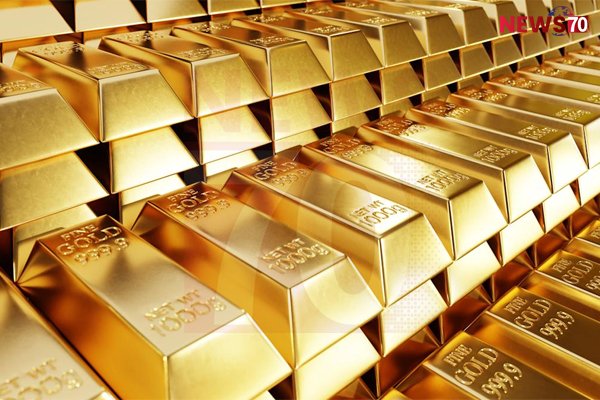
Gold has surged past $4,000 per ounce, marking a record high as investors flock to the safe-haven asset amid global economic and political uncertainty. The rally—gold’s strongest since the 1970s—has been fueled by the US government shutdown, Trump’s tariff policies, and expectations of Federal Reserve rate cuts. Analysts warn prices could dip if the shutdown ends or inflation returns, but long-term sentiment remains bullish as gold continues to attract both institutional and retail investors worldwide.
The price of gold has reached a new record, climbing above $4,000 (£2,985) per ounce, as investors seek safe havens amid rising global economic and political uncertainty.
The precious metal has experienced its strongest rally since the 1970s, gaining over 25% since April, when US President Donald Trump’s tariff announcements rattled global trade.
According to analysts, investor anxiety has also been fueled by delays in key economic data releases caused by the ongoing US government shutdown, now entering its second week.
Often viewed as a safe-haven asset, gold tends to maintain or increase in value during times of market volatility or economic downturn.
On Wednesday morning in Asia, spot gold — which represents the current market price for immediate delivery — surged past $4,016 per ounce. Gold futures, a reflection of market sentiment through contracts to buy or sell the metal later, hit the same level on 7 October.
The US government shutdown, triggered by repeated budgetary deadlocks, is serving as a “tailwind” for gold prices, said Christopher Wong, a rates strategist at OCBC Bank in Singapore.
Historically, investors have flocked to gold during previous US shutdowns, with the metal rising nearly 4% during the month-long closure in Trump’s first term.
However, Wong noted that prices could retreat if the government reopens sooner than expected.
Gold’s “unprecedented rally” in recent weeks has exceeded analysts’ forecasts, said Heng Koon How, head of market strategy at UOB Bank. He attributed the surge to both a weaker US dollar and increased interest from retail investors, or non-professionals, entering the gold market.
Not all investors buy physical gold; many prefer financial instruments such as exchange-traded funds (ETFs) backed by the metal. According to the World Gold Council, a record $64 billion has flowed into gold ETFs so far this year.
Gregor Gregersen, founder of Silver Bullion, a precious metals dealer and storage provider, said his client base has more than doubled over the past year.
He noted that retail investors, banks, and wealthy families are increasingly viewing gold as a shield against global instability. “Most of our clients are long-term holders,” Gregersen said, adding that many store their gold for over four years.
While Gregersen acknowledged that gold prices can decline as well as rise, he believes the current economic climate supports a long-term upward trend, possibly lasting at least five years.
Still, OCBC’s Wong cautioned that gold prices may fall if interest rates rise or if geopolitical and political tensions ease. For example, he said, in April, gold dropped about 6% after Trump decided not to dismiss Federal Reserve Chair Jerome Powell.
“Gold is traditionally seen as a hedge against uncertainty,” Wong said, “but that hedge can be unwound.”
In 2022, the metal’s value plunged from $2,000 to $1,600 per ounce after the US Federal Reserve raised interest rates to curb inflation caused by the Covid-19 pandemic, noted UOB’s Heng.
He warned that a sudden return of inflation could threaten gold’s current rally by prompting the Federal Reserve to hike rates again.
The recent surge in gold, Wong added, reflects market expectations that the Fed will soon cut rates, making gold more appealing.
Meanwhile, Trump has intensified his criticism of the Fed, accusing Chair Jerome Powell of being too slow to lower rates and even attempting to fire Fed Governor Lisa Cook.
Wong said such actions could undermine confidence in the Fed’s independence and its ability to function as a credible, inflation-targeting central bank.
“In this kind of environment,” he added, “gold’s role as a hedge against uncertainty becomes more significant than ever.”