
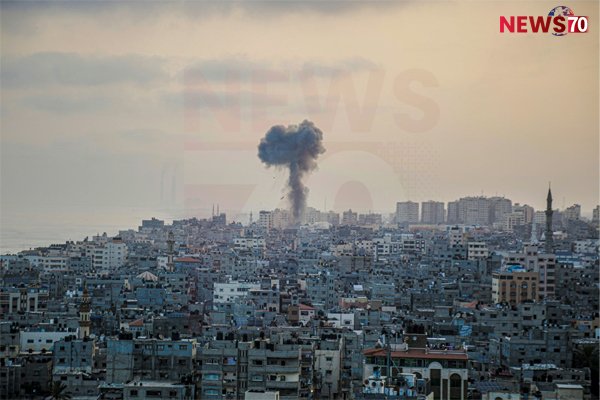
Israel launched strikes on Gaza after accusing Hamas of violating a US-brokered ceasefire with attacks on Israeli forces in Rafah. Hamas denied involvement and said it remains committed to the truce. The incident, which caused Israeli casualties, marks the most serious test of the ceasefire so far. Internal clashes within Gaza and pressure on Netanyahu from far-right allies are escalating tensions.
Israel Strikes Gaza After Alleged Ceasefire Breach by Hamas in Major Test of US-Brokered Truce
Israel launched airstrikes on Gaza Sunday, claiming its forces came under attack by militants in what it described as a “blatant” breach of the ceasefire—marking the first major challenge to the US-brokered truce.
According to an Israeli military official, Hamas fighters targeted Israeli troops in Rafah using sniper fire and rocket-propelled grenades. In response, the Israel Defense Forces (IDF) carried out artillery and airstrikes in the area. The clash occurred beyond the so-called Yellow Line—the withdrawal boundary defined in the ceasefire agreement.
Sources familiar with the incident indicated that the attack led to Israeli casualties. Both sides have traded accusations over ceasefire violations since the truce took effect nine days ago, ending months of fighting and facilitating the exchange of Israeli hostages and Palestinian detainees. However, Sunday’s events represent the most serious threat to the fragile peace so far.
Despite the escalation, Hamas released a statement affirming its continued commitment to the ceasefire, with its military wing—the Al Qassam Brigades—denying involvement in any confrontation in Rafah. “We are committed to the truce throughout all areas of the Gaza Strip,” the group said.
In Israel, Prime Minister Benjamin Netanyahu held a high-level security consultation with Defense Minister Israel Katz and senior military officials. He instructed them to “act forcefully” against Hamas targets. “Hamas will pay a heavy price for every shooting and ceasefire violation,” Katz warned, adding that if the message isn’t understood, “our response will only grow more intense.”
Netanyahu is also facing increasing pressure from hardline members of his coalition, including National Security Minister Itamar Ben Gvir, who has called for a full-scale resumption of the war in Gaza.
Tensions have also been escalating within Gaza itself. On the same morning as the Rafah incident, Hamas announced that its internal Rada’a security forces had launched an operation against a hideout linked to an Israeli-backed militia led by Yasser Abu Shabab. Israel had confirmed earlier this year that it was arming such militias to undermine Hamas.
Muhammad Shehada, a Gaza specialist with the European Council on Foreign Relations, noted that these militias often operate from Israeli-controlled zones in Gaza, conducting raids before retreating to protected areas. The resulting internal strife has led to multiple clashes across the territory, including a public execution of eight individuals in Gaza City witnessed by large crowds.
In parallel, Hamas has initiated a “security campaign” targeting what it calls “collaborators, mercenaries, thieves, bandits, and those cooperating with the Zionist enemy.” Meanwhile, Israel has shot and killed Palestinians it accused of approaching the Yellow Line—an act Hamas labels a “flagrant violation” of the ceasefire terms.
Israel has also accused Hamas of stalling the return of the bodies of deceased hostages, a condition stipulated in the agreement, and has closed a key border crossing until further notice.
As both Hamas and Israel continue to trade blame for violations, the future of the ceasefire remains precarious.