
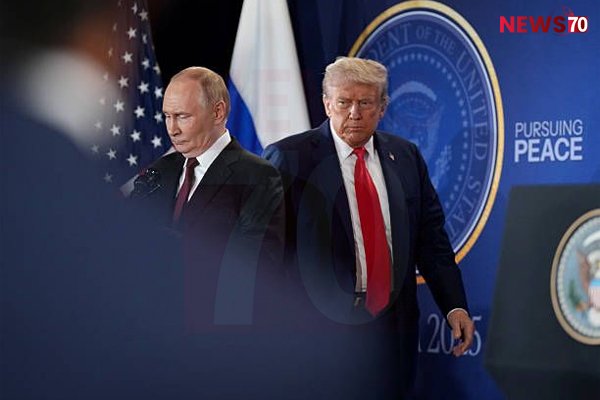
Ukrainian President Zelensky is in Washington to urge President Trump to send Tomahawk missiles to Ukraine. The visit follows a Trump-Putin call and plans for a summit in Hungary, adding urgency to U.S. decisions on long-range arms amid intensified Russian attacks.
Zelensky to Press for Missiles in White House Talks as Trump Eyes Putin Summit
Ukrainian President Volodymyr Zelensky will meet U.S. President Donald Trump in Washington on Friday, aiming to secure Tomahawk cruise missiles capable of striking deep into Russia. The high-stakes meeting comes just a day after Trump held a “very productive” phone call with Vladimir Putin, with both leaders agreeing to an in-person summit in Hungary.
Tensions and Timelines
Zelensky's visit, his third this year, comes at a crucial moment. He warned that Moscow only moves toward dialogue "as soon as it hears about Tomahawks," referencing the long-range missiles he hopes the U.S. will supply. The Tomahawks, with a range of 2,500 km, could allow Ukraine to target infrastructure far inside Russia.
Trump, however, has sent mixed signals. After the Putin call, he expressed concern about depleting U.S. missile stockpiles, stating:
“We need them too… I don’t know what we can do about that.”
While he had previously indicated openness to supplying Ukraine with long-range systems, Trump has emphasized caution since his re-engagement with Moscow.
Putin, Orban, and the Budapest Factor
Putin also held talks with Hungarian Prime Minister Viktor Orbán, who is helping coordinate the proposed Budapest summit. Orbán, known for his pro-Russia stance, called the upcoming meeting “great news for the peace-loving people of the world,” while noting the EU would be sidelined from this process.
Russian state media confirmed that high-level discussions between the U.S. and Russian teams are scheduled next week, led by U.S. Secretary of State Marco Rubio. Trump said he would brief Zelensky on the details of the Putin call during their Friday meeting.
Ukraine Under Fire, Again
Just hours before Trump’s call with Putin, Russia launched one of its largest attacks of the year on Ukraine — unleashing 28 ballistic missiles and over 320 drones. Ukrainian Ambassador Olga Stefanishyna condemned the strikes as proof that "Moscow’s strategy is terror and exhaustion," urging a tougher Western response including long-range weapons and sanctions.
Complicated Military Logistics
Even if approved, deploying Tomahawks to Ukraine won’t be straightforward. The Ukrainian navy lacks the vessels to launch them, and the U.S. has only limited land-based launchers, namely the Typhon system, which was reinstated in 2023. The Pentagon reportedly has just two Typhon units, making supply and training a serious logistical challenge.
Shifting Politics and Optics
Zelensky’s relationship with Trump, once tense, has improved. Back in February, Trump and VP JD Vance harshly criticized him on live TV in the Oval Office. But by September, Trump declared that Ukraine could “win back all its territory,” reversing earlier calls for Kyiv to cede occupied regions.
In July, Trump set Putin a deadline to agree to a ceasefire or face sweeping sanctions a threat he didn’t follow through on once Putin agreed to talks in Alaska. That meeting, though symbolically important, led to no concrete outcomes.
Adding further confusion, Trump claimed this week that Indian Prime Minister Modi had agreed to stop buying Russian oil — a statement India’s government quickly denied, saying no such conversation took place.